
Let's talk about the invisible clock in the bedroom
You're with your partner. Things are building. And then, somewhere in your nervous system, a timer goes off. Not an actual timer. Something quieter and meaner. The sense that you're taking too long, that your partner is waiting, that your body needs to hurry up and do the thing so everyone can move on.
That pressure kills arousal dead. And it's almost never actually coming from your partner.
Why the timeline trap feels so real
Here's what's actually happening physiologically. When you're focused on whether you're taking too long, your brain has split its attention. Half of it is in your body, tracking sensation. The other half is watching yourself from above, narrating the performance. That spectator mode is the exact opposite of what your nervous system needs to build toward orgasm.
Therapists call this "spectatoring," and it's one of the most common orgasm blockers I see in my practice. The research backs this up. A 2015 study in Archives of Sexual Behavior found that people who experience performance pressure during sex show measurable delays in arousal and orgasm, even when they're physically stimulated exactly the same way.
Why? Because your clitoris doesn't care about the clock. It cares about sustained, relaxed attention. The moment you inject anxiety about speed, you're asking your body to do something neurologically impossible. You can't be both deeply present and watching yourself fail.
The real conversation you need to have with your partner
Most of the time, your partner has no idea you're feeling this pressure. You might not have told them because you don't want to hurt their feelings, or because you assume they should already know, or because the pressure feels so internal that you're not sure how to name it.
Start here: "I want to check in about something that's been on my mind. I sometimes feel like I'm rushing my pleasure to keep pace with you, and I think I'm in my own head about that. I don't think you're doing anything wrong. I just want us to talk about how to make space for my body to do its thing on its own timeline."
That sentence does three things at once. It says what's happening without blame. It reassures your partner they're not the bad guy. And it opens a door instead of closing one.
The best partners actually want this information. They don't want you pretending to orgasm. They don't want you white-knuckling your way to a finish line. They want you genuinely present. That conversation, awkward as it might feel, is how you get there.
How lemon clitoral vibrators help you reclaim your pace
This is where tools like the Lem come in, and not in the way you might think. It's not that the vibrator does the work for you. It's that external stimulation gives you permission to stop performing and start feeling.
Here's why: when you're using a clitoral vibrator, the responsibility for sensation isn't balanced on you. You're not trying to get there. You're not managing your partner's experience while managing your own. You have a tool that's literally designed to keep stimulation steady while your nervous system settles. That external focus takes the pressure off your internal narrative.
Lemon vibrators, especially suction-style designs, work particularly well for this because they bypass the friction-based sensation that can feel effortful. Suction stimulation engages different nerve pathways, and it often feels less like work and more like waves of sensation. You're not trying to push toward something. You're receiving.
The three-part framework that actually works
If you're going to introduce a clitoral vibrator into partnered sex specifically to ease the pressure-to-orgasm problem, do it intentionally. Here's how.
Part one: Solo rehearsal. Spend time with the vibrator alone first. This isn't foreplay. This is you learning what your body actually wants, without an audience. Notice what pattern feels best, what intensity, what rhythm. This data is gold. You're not trying to come. You're just learning to listen to your own nervous system. Five to ten minutes is enough. The goal is permission, not performance.
Part two: The conversation. Tell your partner exactly what you learned. "I found that I like starting on pattern three, and I need about fifteen minutes before I feel like I'm ready for more. When I'm using the vibrator, I don't want you to do anything except maybe kiss my neck or hold my hand. I want to feel you there, but I don't need you to perform." Specificity is kindness. It tells your partner exactly how to show up.
Part three: Integration. Next time you're together, use the vibrator the exact way you practiced. Your partner can be involved or not. What matters is that you're following your own rhythm, not syncing to theirs. If your partner finishes first, you keep going. If it takes you thirty minutes, it takes thirty minutes. The clock stops.
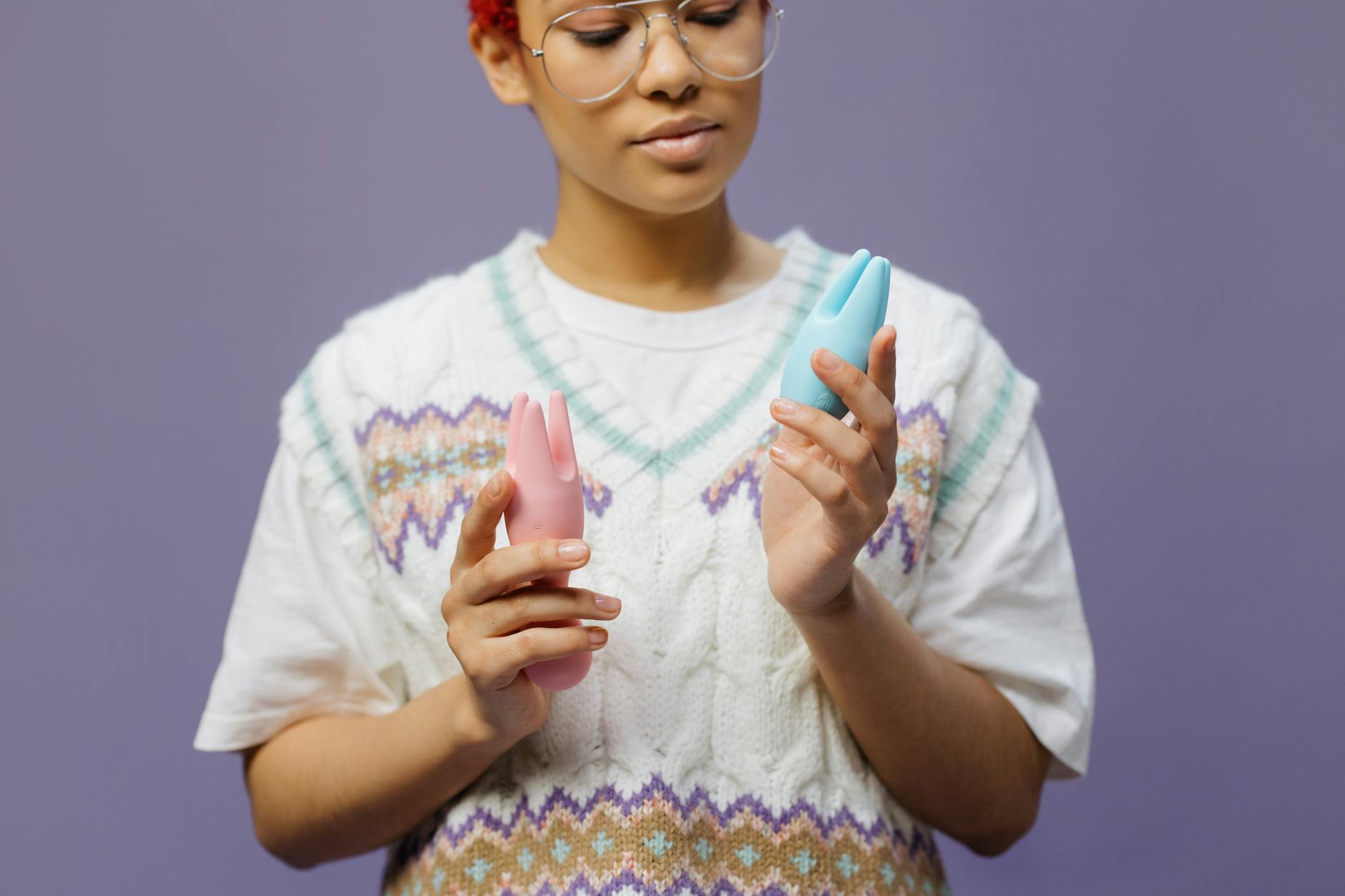
Photo by cottonbro studio on Pexels
What to do if your partner feels threatened or left behind
Some partners initially feel anxious when you introduce a vibrator. It can feel like rejection, or like you're admitting something is wrong with them. This is worth naming directly.
Try this: "I'm using this for me, not against you. I actually feel more relaxed and more present with you when I'm not pressuring myself. When I stop spectating and start feeling, I can actually be more with you. This helps that happen."
The magic words are "more with you." Because it's true. A partner who's in her own head, watching herself, worried about taking too long, is actually less available. A partner who's dissolved into sensation, who's stopped narrating, who's actually feeling? That's the version who shows up more fully.
If your partner continues to feel uncomfortable, that's different information. That might mean you need to talk more about what pleasure looks like for both of you, or it might mean you need actual couples therapy. But the pressure-to-orgasm conversation is separate from the vibrator conversation. Deal with both.
When the pressure comes from inside, not outside
Sometimes your partner isn't the one watching the clock. You are. You've internalized the message that female pleasure is supposed to be efficient, or that you're being selfish by needing so much time, or that your body should work faster than it actually does.
If that's your situation, a vibrator is still useful, but the real work is the internal permission piece. Using the Lem becomes a way to practice not rushing. You're literally telling your body: "Take whatever time you need. This is for you. No one is waiting."
That might feel awkward the first five times. By the tenth time, it becomes a groove. Your nervous system learns that it's actually safe to slow down instead of speed up.
The orgasm isn't the point anymore
One of the most freeing things I tell clients is this: the moment you stop treating orgasm as the finish line, it usually shows up more reliably. Not because you're trying harder. Because you've actually stopped trying.
When you're using a clitoral vibrator and you've genuinely released the pressure, one of two things happens. Either you orgasm pretty easily, because your nervous system is finally relaxed enough. Or you don't, and that becomes interesting instead of frustrating. You might discover that the pleasure itself, the buildup, the sensation without the release, is actually what you've been hungry for.
Both are wins. Both are you coming back home to your own body.
FAQ
How long should I wait before introducing a vibrator to partnered sex if we haven't used toys before?
There's no rule. Some couples incorporate tools into partnered sex right away. Others spend months exploring solo first. What matters is that you introduce it when you've had the underlying conversation about pressure and timeline. The vibrator is a tool. The conversation is the foundation. If you try to solve the pressure problem with just the tool and skip the conversation, it won't work.
What if using a vibrator makes my partner feel like he's not enough?
That's a real fear, and it's worth taking seriously. But here's the thing: you using a tool doesn't mean he isn't enough. A vibrator can't replace a partner. It can't hold you. It can't look in your eyes. What it does is help your nervous system access a type of stimulation that your partner's hand alone might not provide. Frame it that way. "This helps me relax, which means I can actually be more present with you." If he still feels threatened after the conversation, that might be a sign that some of his own stuff about sufficiency and performance is in the way. That's therapeutic territory, not vibrator territory.
Can I use a clitoral vibrator if I'm on antidepressants that numb my sensation?
Yes, and in fact, that's one reason some people find lemon vibrators so useful. Suction-style vibrators often access sensation differently than hand stimulation or vibration alone. That said, if medications are significantly flattening your capacity for pleasure, that's worth discussing with your prescriber. Sometimes a dose adjustment or a medication switch can help. The vibrator works best when you're already in a place where some sensation is available.
What's the difference between using a vibrator solo versus with a partner, in terms of the pressure you're feeling?
Solo, the pressure is entirely internal. You're managing your own expectations, your own timeline, your own performance anxiety. With a partner, the pressure has another person's energy in it, even if they're not doing anything wrong. Sometimes using the vibrator solo first helps you practice releasing that internal pressure. Then, when you bring it into partnered sex, you're working with what you've already learned. You're not learning to let go of external pressure and internal pressure simultaneously.
Is it normal to need twenty or thirty minutes with a clitoral vibrator before orgasm feels close?
Completely normal. In fact, twenty to thirty minutes is actually the median for people with vulvas across the board. The "five minute" orgasm is marketing fiction. Your body takes the time it takes. Using a tool like the Lem actually gives you the consistency and staying power to get through those twenty or thirty minutes without fatigue or losing sensation. That's partly why these vibrators work so well for pressure-related issues. They don't get tired. Your hand does.
What if my partner wants to be involved in every stage, but I need some time alone with the vibrator first?
Then you tell them that. "I need ten minutes to myself with this first, then I'd love for you to join." That's it. That's the whole conversation. Good partners respect clear requests. If they don't, that's not a vibrator problem. That's a boundary problem, and that's worth addressing separate from the pleasure conversation.
One more thing before you close this tab
The pressure you're feeling is real, and it's not because anything is wrong with your body or your desires. It's because pleasure culture doesn't make much room for the reality that arousal takes time, that timelines don't sync, and that your orgasm isn't a performance for an audience. The moment you decide that your pleasure matters enough to take whatever time you need, everything shifts. A tool like the Lem just gives your nervous system permission to believe that's actually true.
If you want to dig deeper into how mismatched arousal rhythms actually work in long-term relationships, or how to have these conversations with a partner who struggles to hear them, reach out at /contact. We're here to help with the actual conversations underneath the pleasure piece.