The performance trap nobody talks about
Let's be real. Most people with vulvas have experienced this: your brain is already halfway through the scene before your body even shows up. You're monitoring yourself. Wondering if you're taking too long, if your sounds are the right sounds, if your partner is getting bored, if you look weird from this angle. The internal monologue never stops, and by the time you notice it, arousal is gone.
That's performance anxiety. It's not the same as nervousness before a first time with a new partner. This is the insidious version. It's the voice that shows up even in long-term relationships, even when you theoretically trust your partner completely. It's the belief that your pleasure is something you need to earn or prove.
How performance anxiety actually kills arousal
Here's the physiology. Arousal requires parasympathetic nervous system activation. That's your rest-and-digest system. Meanwhile, performance anxiety triggers your sympathetic nervous system. That's fight-or-flight. The two cannot coexist. Your body cannot simultaneously relax into pleasure and prepare to defend itself.
When you're in performance mode, your brain is flooded with cortisol and adrenaline. Blood flow stays in your extremities and your large muscle groups. It stays out of your genitals. Lubrication decreases. Arousal plateaus at a frustrating middle point and never climbs further. Then you get frustrated that you're not climaxing, which kicks anxiety higher, which makes arousal even harder. It's a perfect negative feedback loop.
The typical advice is "just relax" or "focus on sensation." That's technically correct but wildly unhelpful. You can't think your way out of anxiety. But you can structure an experience that makes anxiety harder to maintain.
Why lemon clitoral vibrators change the game
A lemon vibrator, especially a suction-based adult toy like the Lem, works differently than your hand or a partner's touch. That difference is the whole point.
When you use your hand, you're still the director. You're still controlling the rhythm, the pressure, the speed. Some part of your brain stays occupied with those decisions. With a partner, there's an additional layer: you're aware of their presence, their reactions, their performance too.
With a lemon clitoral vibrator, particularly a suction toy designed for hands-free use or minimal input, the stimulation is constant and self-directed. You push a button. It does the work. Your job is just to receive.
That shift from active performer to passive receiver is neurobiology. When your locus of control moves outside yourself, your brain has fewer resources left to monitor, critique, and judge. Performance anxiety needs your active participation to survive.
The specific setup that works
If you're someone who feels watched or judged during sex, the physical context matters. Here's what I recommend.
First: solo. Use a lemon adult toy on your own first. Not as a supplement to partnered sex, but as its own legitimate experience. Alone, you don't have to manage anyone else's experience. You're not tracking whether your partner is bored. You're not performing. You're just exploring.
Spend 2-3 solo sessions with your lem vibrator before you consider bringing it into partnered play. The goal isn't to achieve orgasm quickly. It's to reprogram your nervous system's baseline: pleasure can happen without audience, without performance, without proving anything.
Second: low-stakes partnered use. When you do bring a lemon vibrator into a partnered scenario, frame it explicitly as exploration, not performance. The conversation matters here. Instead of "I want to use this during sex," try "I'm curious how this feels and I'd like you to be here with me, but there's no goal or timeline."
Often, people feel pressure because there's an assumed endpoint. Sex happens, someone should orgasm, everyone should be satisfied, scene closes. Using a lemon clitoral vibrator without that narrative is surprisingly freeing. "We're going to spend 20 minutes exploring how this feels" sounds almost casual by comparison.
Third: hands-off positioning. The Lem and similar suction-based lemon sexual toys allow for hands-off use. That's intentional. You can position yourself and let the toy do the work while your hands are free to touch your partner, rest, or just exist. Freed hands often mean freed mind. Less to manage = less to perform.
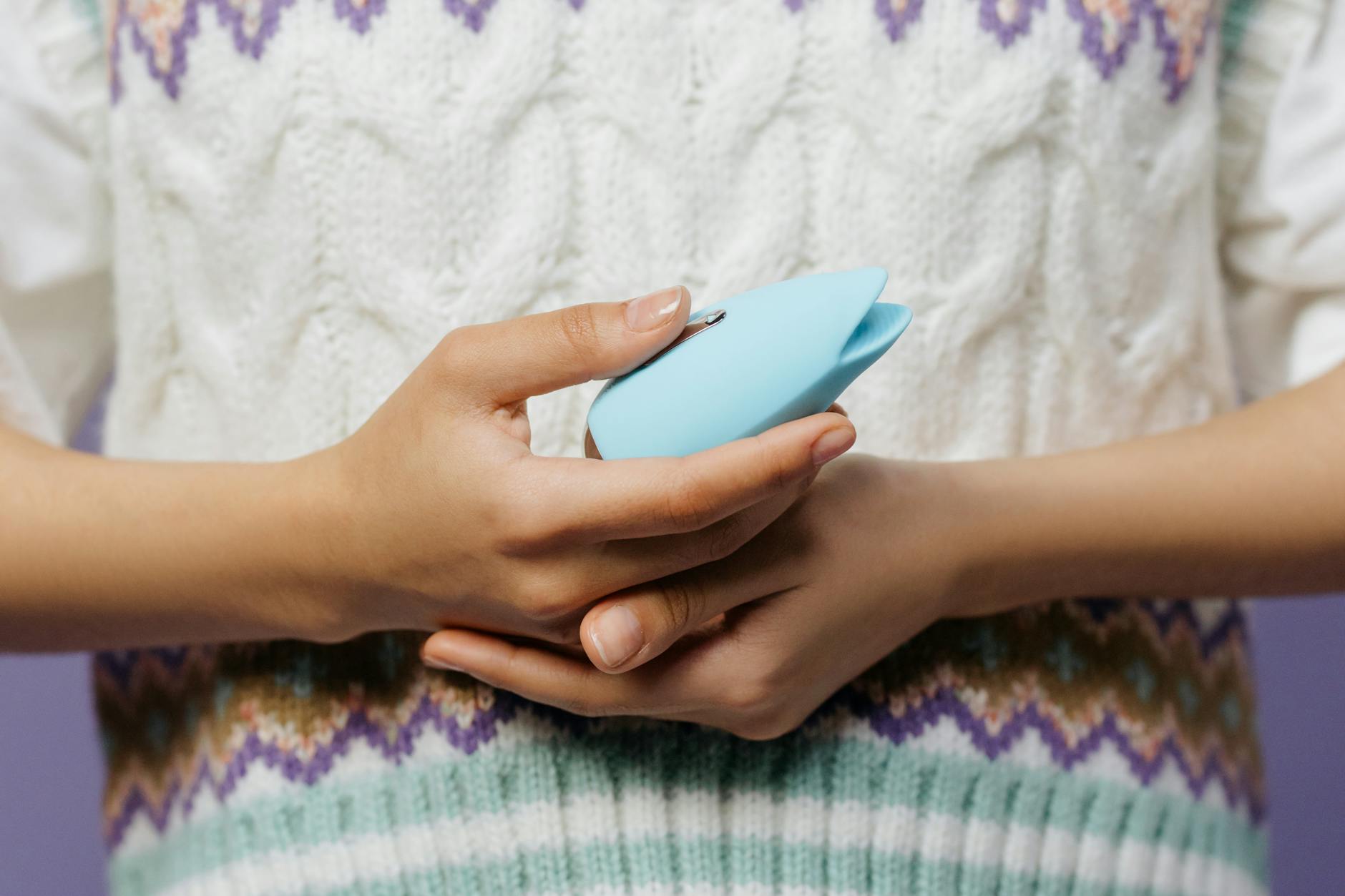
Photo by cottonbro studio on Pexels
Reframing what "success" means
Performance anxiety thrives on outcomes. Did I orgasm? Did I orgasm fast enough? Did my partner think it was good? Did it look a certain way?
When you're using lemon vibrators, deliberately shift the metric. Success becomes: Did I notice sensation? Did I feel anything new? Was I present for any moment, even briefly? Did my body relax at any point?
Orgasm is fine if it happens. But it's not the win condition. Presence is. Curiosity is. Sensation is.
This is why solo sessions matter so much. You need proof that you can experience pleasure without performing. Once you've had that experience a few times, the belief that "I must earn this" starts to weaken. Your nervous system learns a new pattern.
Then, when you introduce a lemon clitoral vibrator with a partner, you're not restarting from panic. You're building on a foundation of "I know this works when I'm not performing."
The conversation you actually need to have
If you're in a relationship and performance anxiety is showing up, your partner probably senses it. They might be feeling their own pressure too. Many people with partners feel anxious because they believe their partner is waiting for them to climax, or worrying that the partner will get tired or bored.
Talk about it directly. Not during sex. Not when you're already vulnerable. Talk about it over coffee, casually. "I've noticed I get in my head during sex and I think it's killing the experience for both of us. I want to try something different."
Then explain: using a lemon vibrator feels safer because there's less to perform. There's no hidden script. You're not trying to hit an invisible mark. It's just exploration.
If your partner is defensive about vibrators, that's separate information. And it's worth examining. But most partners, when they understand that introducing a toy reduces their partner's anxiety, are genuinely relieved. Pressure to perform isn't fun on either side.
Related reading: how to use lemon vibrators when your partner has resistance walks through that conversation in detail.
What happens next
After a few weeks of regular use, your nervous system starts recalibrating. You've spent enough time receiving stimulation without judgment that the panic response quiets down. Arousal builds faster. Distracting thoughts interrupt less frequently.
You might notice that you can now use a lemon clitoral vibrator with a partner without the internal monologue running quite so loud. You might find that pressure to perform lessens in other sexual contexts too, because you've proven to yourself that pleasure doesn't require performance.
Some people eventually stop needing the vibrator for every encounter because the anxiety has loosened its grip. Others use it regularly because it just feels better. Both are fine. The goal was never to become dependent on a toy. The goal was to interrupt the anxiety loop.
You deserve pleasure that doesn't require proving anything. A lemon vibrator isn't magic, but it does remove friction. And sometimes, removing friction is exactly what breaks the cycle.
People also ask
Why does performance anxiety kill arousal faster than other types of anxiety?
Performance anxiety is recursive. Other anxiety might distract you from sex. Performance anxiety actually makes you hyperfocused on sex. You're monitoring every sensation, every sound, every micro-movement. That hypervigilance prevents the passive state arousal requires. It's the cognitive equivalent of flexing a muscle when you're trying to relax. The more you focus on whether it's working, the harder it becomes to work.
Can using a lemon vibrator alone actually lower my overall anxiety about sex?
Yes, but only if you're using it as genuine solo exploration, not as rehearsal for partnered sex. The key difference is intention. If you use it alone thinking "I'm practicing so I can perform better with my partner," you're still in performance mode. If you use it thinking "I'm just going to explore what feels good right now," your nervous system is in a different state. That difference compounds. After several solo sessions in the exploratory frame, your brain learns a new default.
What if I get anxious even when I'm alone with a vibrator?
That's worth noticing. Some people carry performance anxiety so deeply that it shows up even solo. If that's you, the vibrator alone won't fix it, but it can be a tool alongside other work. Using lemon vibrators when you feel disconnected from your body covers rebuilding that connection. You might also benefit from therapy, specifically around performance anxiety. A therapist can help you understand where the belief that you must earn pleasure came from.
Is it normal for my partner to feel threatened by a vibrator if I say it's about reducing my anxiety?
It's common, though not universal. Some partners worry that introducing a toy means their touch isn't enough. Have that conversation explicitly. "I'm using this because I get in my head. It's not about your touch. It's about my nervous system. And honestly, it might make me less anxious when we're together, which means more relaxed, which means better for both of us." If your partner still resists after you've explained clearly, that's relationship information you need to process separately. But most people are fine with it once they understand the actual reason.
Can I use a lemon clitoral vibrator for performance anxiety if I'm single?
Absolutely. In fact, solo use is the cleanest way to interrupt the anxiety loop. There's no performance happening at all. You're just exploring sensation. And when you eventually have partnered sex again, you'll carry that experience with you: a baseline understanding that pleasure doesn't require earning. That shift alone often reduces anxiety in partnered contexts.
What if the vibrator itself makes me anxious because I'm worried I'm using it wrong?
That's worth naming. Start with the absolute simplest use. No patterns, no intensity changes, just the basic setting for 5 minutes. The point isn't to achieve anything. It's just to get used to the sensation without stakes. If lemon vibrators make you anxious in themselves, that's separate from performance anxiety and might warrant exploring why. But most people find that once they've tried a basic setting a few times, the anxiety around "using it right" fades.
Final thought
Performance anxiety is a learned response. That means it can be unlearned. A lemon vibrator isn't the only tool, but it's a good one because it removes a layer of performance from the equation. Use it as an invitation to yourself: pleasure doesn't have to be earned. It can just be received.
If you're ready to explore, start solo. Give yourself permission to learn what your body actually wants, separate from what you think you should want. That foundation changes everything.
Have questions about getting started? Reach out.